


Article
What Is B2B? How Is It Different from B2C in the Business World?
What Is B2B? Understanding the Business-to-Business Model, with Examples, Key Differences from B2C, and the Technologies That Help Businesses Grow in the Digital Era
B2B (Business to Business) is a business model that plays a vital role in the digital economy. Whether they are manufacturers, distributors, technology companies, or enterprise service providers, many organizations operate under the B2B model—especially in an era when technology and online payments have become central to business operations.
This article will help you understand what B2B is, how it differs from B2C and B2B2C, along with examples of B2B businesses and guidance on choosing the right Payment Gateway for modern organizations.
Key Takeaways
- B2B refers to a business model in which organizations conduct transactions with other organizations by selling products or providing services to one another.
- B2B businesses cover both products and services, such as SaaS, Payment Gateways, Data Analytics, and Cybersecurity, all of which are growing in line with the Digital Transformation trend.
- The difference between B2B and B2C lies in the customer group: B2B focuses on transactions between organizations, while B2C focuses on selling products and services directly to end consumers.
- Choosing the right Payment Gateway for a B2B business helps improve cash flow management, supports multiple payment methods, and makes online transactions more seamless.
Article Contents
- What is B2B? What does it stand for?
- What types of B2B businesses are there?
- How is B2B different from B2C?
- Comparison table: B2B vs. B2C vs. B2B2C
- 4 examples of B2B business strategies that are trending today
- What are the signs that a B2B business needs to upgrade its Payment Gateway system?
- How should businesses choose the right Payment Gateway for B2B?
- Which Payment Gateway solutions are suitable for B2B?
- Frequently Asked Questions (FAQs)
- B2B is a key engine driving business growth in the digital era
What is B2B? What does it stand for?
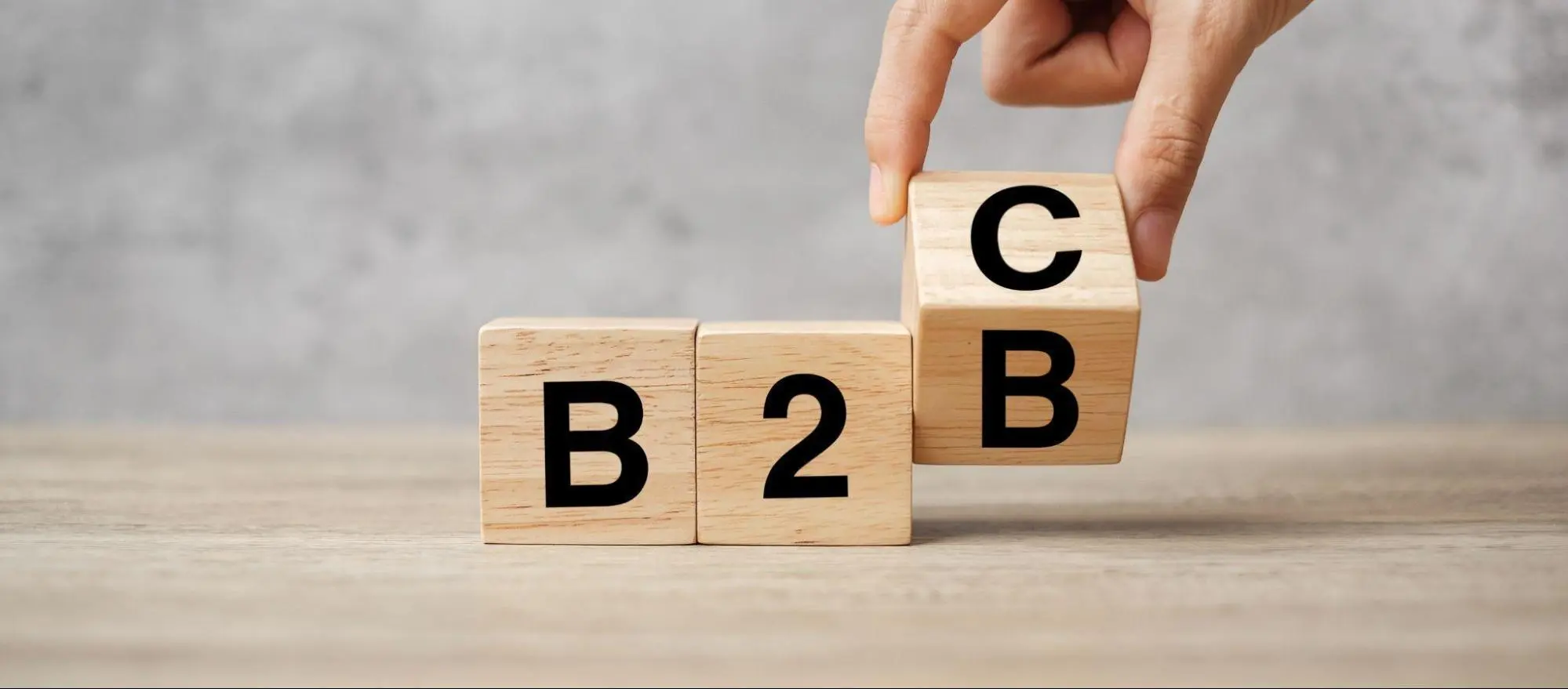
Business to Business, or B2B, refers to commercial transactions conducted between one organization and another. Examples include manufacturers selling products to distributors, companies selling products or services to other companies, or system providers offering solutions that organizations use in their operations. In general, B2B transactions tend to involve higher deal values and may include contracts or specific terms and conditions. The decision-making process is usually longer because multiple stakeholders are involved, such as end users, approvers, procurement teams, and finance departments. As a result, trust, professionalism, and after-sales service are essential in doing business.
Today, B2B businesses span industries ranging from technology and online marketing to finance and Payment Gateway systems that make inter-company payments faster and more convenient than ever.
What types of B2B businesses are there?
B2B businesses can be categorized in several ways, depending primarily on the type of products or services they deliver to customers. Examples include the following:
Products
Product-based B2B businesses are those that sell goods to organizations, such as factories, manufacturers, or retail distributors. Examples include office equipment manufacturers, POS system or storefront equipment providers, and distributors of hardware or technology devices. These types of businesses often handle large-volume orders, require order management systems, and typically need payment solutions that support accounting and procurement operations, such as payment reports, reconciliation, and supporting documentation.
Services
Service-based B2B businesses operate under a business model in which organizations provide services to other organizations, such as software companies, consulting firms, accounting systems, and HR systems. This segment is growing rapidly as many organizations continue to adapt to Digital Transformation. It also includes the adoption of FinTech solutions—financial technologies that improve convenience in business operations, increase efficiency, reduce costs, and enable more automated workflows.
How is B2B different from B2C?
B2B and B2C are two business models that differ clearly in three main areas, as follows:
- Customer group: B2B involves high-volume purchasing and selling between organizations, while B2C focuses on selling directly to individual consumers.
- Decision-making process: B2B decisions are based on logic, business value, and approval from multiple stakeholders, which makes the sales cycle longer. In contrast, B2C decisions are often influenced by emotions, satisfaction, or promotions, allowing deals to be closed more quickly.
- Relationship model: B2B emphasizes long-term partnerships and ongoing account management, whereas B2C focuses on delivering a fast and satisfying experience in each transaction.
In addition, both B2B and B2C businesses may use common tools such as CRM systems, ERP systems, or NDID, a digital identity verification system, to improve security and reduce transaction risk.
Comparison table: B2B vs. B2C vs. B2B2C
Each business model has its own strengths. Understanding the differences between B2B, B2C, and B2B2C can help businesses choose strategies that best fit their context.
|
Business Model |
Business Characteristics |
Customer Group |
Example |
|
B2B |
Businesses sell to other businesses |
Organizations / companies |
A software company sells an ERP system to businesses |
|
B2C |
Businesses sell to consumers |
General consumers |
An online store sells products directly to retail customers |
|
B2B2C |
A business works with an “intermediary” to reach end consumers |
Organizations and consumers |
Marketplace / E-Commerce platform |
B2B2C is a model in which one business collaborates with another business to deliver products and services to consumers, such as an e-marketplace platform or an E-Commerce platform that aggregates merchants and sells to end customers.
4 examples of B2B business strategies that are trending today

Here are examples of B2B marketing strategies in 2026 that focus on building credibility, increasing the chances of closing deals, and achieving long-term growth:
Account-Based Marketing (ABM)
Target specific companies with highly focused marketing efforts, such as creating industry-specific content or tailoring the sales pitch to the unique needs of each target organization.
AI-Driven Personalization for B2B
Modern technology makes it easier to analyze customer data and tailor messaging, pricing, packages, or offers to each organization at an individual level through hyper-personalization.
Thought Leadership & Content Authority
Rather than competing primarily on price, businesses compete on credibility—for example, by publishing in-depth articles, reports, webinars, or having executives share industry perspectives to build a strong expert image.
Revenue Operations (RevOps)
Revenue Operations (RevOps) is the shift from siloed work across Marketing, Sales, and Customer Success teams to a unified data foundation that focuses on pipeline quality and total organizational revenue, rather than simply counting leads in the traditional way.
When combined with a Product-Led Growth (PLG) strategy in B2B software or digital service businesses that offer free trials (Freemium/Self-serve), RevOps can help customers recognize product value more quickly. It also helps convert active users into Product Qualified Leads, enabling RevOps teams to pass behavioral insights to sales teams so they can close deals more accurately and scale up to enterprise packages with maximum efficiency.
What are the signs that a B2B business needs to upgrade its Payment Gateway system?
As a business begins to grow or plans to expand in the long term, its payment system—or Payment Gateway—becomes an important part of the infrastructure needed to support that growth efficiently. Signs that your B2B business should consider upgrading its payment system include the following:
- The business is seeing a continuous increase in orders and transaction volume
- You want to reduce payment friction and speed up the payment process
- You are starting to serve international customers or need to support multiple currencies and payment channels
- You need to support multiple payment methods such as QR Code and credit cards
- You want to integrate the payment system with backend business systems
- You want to improve financial operations with more structured processes, such as reconciliation reports and payment status tracking
- You want to reduce the manual checking of payment slips and mitigate the risk of fraudulent proof of payment in order to support cashless B2B transactions
How should businesses choose the right Payment Gateway for B2B?
B2B businesses need a payment solution that is fast, secure, and easy to manage. It should include features that make collections and payment verification more systematic, such as:
- Flexible APIs or plugins that can integrate with the organization’s core management systems
- A dashboard with detailed transaction visibility to help accounting teams review payments, perform reconciliations, and issue tax invoices more quickly and conveniently
- Support for payment methods that meet organizational needs, along with the ability to configure payment terms based on business agreements
- Strong security features, including access control and approval workflows that align with each company’s structure
- A dedicated support team and clearly defined service level agreements (SLAs) to ensure system continuity and timely issue resolution
Which Payment Gateway solutions are suitable for B2B?
B2B businesses often require a variety of payment models, such as monthly billing, invoicing, or installment payments. Choosing the right Payment Gateway can therefore make transaction management much more convenient.
- Card Recurring refers to automatic recurring credit or debit card charges, making it ideal for subscription businesses, SaaS, CRM, or monthly services.
- Online Direct Debit refers to automatic account debits after customer authorization, making it suitable for businesses that collect recurring payments such as membership fees, utility bills, or school fees.
- Installment is a credit card installment payment solution that makes it easier for customers to make purchasing decisions, while allowing the business to receive payments according to the agreed payout cycle.
- Payment Links+ allows businesses to send payment links directly to accounting or procurement teams. Once payment is completed, status and transaction details can be easily reviewed via the dashboard.
Frequently Asked Questions (FAQs)
How should a business get started with B2B selling?
Start by analyzing your target audience and industry, defining your value proposition or competitive advantage, establishing your sales and customer management process, and choosing communication channels and content that are suitable for decision-makers.
What type of Payment Gateway is suitable for B2B businesses that use invoicing or recurring billing?
It is recommended to choose a solution that supports recurring payment models, such as Card Recurring, Online Direct Debit, or Payment Links+, along with a transparent reporting system. This helps businesses reduce payment follow-up work and manage cash flow more effectively.
B2B is a key engine driving business growth in the digital era
B2B is a business model driven by rational decision-making, credibility, and long-term relationship building—making it a strong foundation for sustainable growth in the digital era. Whether growth is powered by strategies such as Account-Based Marketing (ABM), AI-Driven Personalization, or RevOps, one thing organizations should not overlook is an efficient payment system that can genuinely support scale. This includes transaction capabilities such as elastic TPS, automated refund management through Refund APIs, and proper system load distribution through dynamic load balancing to ensure uninterrupted business operations.
KGP is ready to be your payment partner for B2B businesses with a full range of solutions, including Card Recurring, Online Direct Debit, Installment, and Payment Links+, helping make payment collection more convenient, easier to verify, and more efficient to manage.
KGP, Payment. Make It Smooth.
Related News/Articles
Follow Us